


The way search engines consume your website is shifting. For two decades, we optimized for keywords and backlinks. Now, with the rise of Large Language Models (LLMs) and Google’s Search Generative Experience (SGE), we are optimizing for understanding.
If your Magento store is a disorganized mess of unstructured data, AI tools cannot parse it, categorize it, or recommend it to users asking complex questions. You might have the best product on the market, but if an LLM can’t clearly interpret your data hierarchy, you don’t exist in the new search landscape.
We see this constantly during audits. Brands spend thousands on “creative” copywriting that confuses bots, or they leave their Magento attribute sets in shambles. Organization is no longer just about housekeeping; it is a primary revenue driver. Here is how to restructure your e-commerce content so that both humans and AI models can actually understand what you sell.
Stop Feature-Dumping in Product Descriptions
Most product descriptions we audit are either barren wastelands of technical specs or fluff-filled paragraphs that bury the actual value. Neither approach works for LLMs. These models look for relationships between attributes and benefits.
When we handle product description projects, we move beyond simple text blocks. We implement structured attribute-benefit frameworks. If you sell technical equipment, you cannot just list “4000mAh battery.” You need to structure the data so the model understands the implication: “4000mAh battery providing 12 hours of continuous operation.”
This requires a consistent taxonomy across your entire Magento catalog. If one product page uses “Dimensions” and another uses “Size,” or if your attribute sets vary wildly between similar categories, you break the pattern recognition that AI relies on.
For complex catalogs, we recommend layering the complexity. Lead with the essential information that answers the immediate user intent, then progressively disclose technical details. This helps LLMs extract and compare specific attributes. When a user asks a chatbot, “Which industrial pump has the highest flow rate under $500?” the answer depends entirely on how clearly you have structured that specific attribute data.
Your Headings Are a Roadmap, Not Decoration

We often see Magento themes where H2 and H3 tags are used purely for font sizing rather than logical structure. This destroys the information architecture of your page.
LLMs read your content like a library index. They need a clear hierarchy to understand the relationship between concepts. If your “Shipping Policy” H2 is nested under your “Product Specs” H2 because of a sloppy template coding, the AI assumes a relationship that doesn’t exist.
We approach on-page optimization with a strict progressive information architecture. Your content should follow a logical outline: H2s are the main chapters, H3s are the sub-chapters. For technical content, we use a consistent pattern: Concept → Explanation → Example → Application.
This structure allows LLMs to retrieve specific “chunks” of content to answer queries. If you have a massive guide on “Magento Performance Optimization,” and a user asks Google, “How do I configure Varnish cache?”, a well-structured H3 section dedicated to Varnish allows the search engine to pull that specific answer. If that information is buried in a wall of text without a heading, it gets missed.
The Cost of Inconsistent Terminology
Inconsistent terminology is one of the fastest ways to confuse a search algorithm. We see this frequently with brands trying to be “creative” with their naming conventions. Calling a product a “jumper” on the category page, a “sweater” on the product page, and a “knit” in the meta data creates semantic friction.
You need a controlled vocabulary. This is a formal definition of your primary terms, synonyms, and related concepts. Once defined, these must be used consistently across your site, from your H1s to your image alt text.
This is why our brand voice development process includes specific style guides for terminology. It isn’t just about brand policing; it’s about helping LLMs build an accurate knowledge representation of your domain. If you are in a specialized industry, such as medical supply or automotive parts, consider implementing a visible glossary. This provides a reference point for LLMs to understand exactly what you mean when you use industry-specific jargon, reducing the chance of “hallucinations” or misinterpretation.
Structuring FAQs for Machine Reading
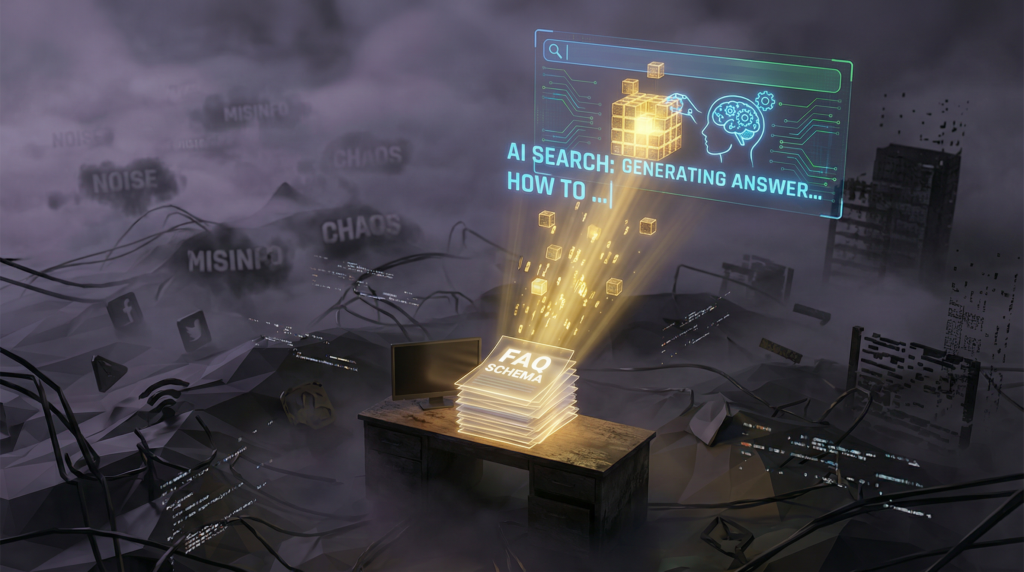
Frequently Asked Questions are often treated as an afterthought—a place to dump miscellaneous information that didn’t fit elsewhere. This is a wasted opportunity. Well-structured FAQs are high-quality training data for LLMs.
We structure FAQs using proper Question-Answer formatting wrapped in FAQPage schema markup. This tells Google explicitly, “This is a question, and here is the definitive answer.”
Don’t prioritize these based on what marketing wants to say. Prioritize them based on what users actually ask. We analyze customer support data and search query reports to build these sections. For complex products, we implement nested FAQs that start broad and get progressively more specific.
When you structure your FAQs effectively, you increase the probability of your content being used as the direct answer in a generative search result. You control the narrative because you provided the structured data the model needed to form its answer.
The Bottom Line
The era of tricking search engines with keyword stuffing is over. The new battleground is data structure and clarity. LLMs crave organization. They reward sites that make information easy to retrieve, compare, and synthesize.
If your Magento site’s content is unstructured, you are invisible to the next generation of search tools. We have seen consistent terminology and technical remediation drive organic traffic increases of 40-60% because the site finally became intelligible to search crawlers.
Your content needs to be as engineered as your code. If you aren’t sure if your current structure is holding you back, we can review your architecture and tell you exactly where the gaps are.
META DESCRIPTION: Is your Magento store optimized for AI search? Learn how structured data, consistent terminology, and clear hierarchies help LLMs understand and rank your products.
Ready to ensure your Magento store is accessible to LLMs?