


When we audit Magento stores, we usually find two very different websites existing on the same domain. There is the visual site that human customers see—the glossy product photography, the user reviews, and the carefully crafted “Add to Cart” buttons. Then there is the code-level site that search engines, crawlers, and Large Language Models (LLMs) see. For many e-commerce brands, that second site is a disaster zone of broken communicative structures and missing context.
We spend a significant amount of time explaining to clients that optimizing a website requires catering to these two distinct audiences simultaneously. While your creative team focuses on the human experience, the technical reality is that if machines cannot parse your data, your human audience will never find you. With the rise of AI-driven search and LLMs, “speaking machine language” has moved from a technical nice-to-have to a fundamental requirement for revenue generation.
The days of relying solely on keyword density and backlinks are over. Modern search engines and AI assistants function more like database readers than traditional crawlers. They require structured, standardized data formats to understand the relationships between your products, your brand, and your content. If you aren’t feeding them this data in a format they expect, you are effectively invisible.
The Foundation: Schema.org and JSON-LD
The most direct way to speak to machines is through Schema.org markup. This is not about adding invisible keywords; it is about providing a strict dictionary definition of your content. For Magento merchants, this usually means implementing JSON-LD (JavaScript Object Notation for Linked Data) to define entities and relationships explicitly. While Microdata and RDFa were common in older Magento 1 implementations, JSON-LD is the preferred standard today because it separates the data layer from the HTML structure, making it less likely to break when your frontend team updates a theme.
We frequently see Magento themes that claim to be “SEO ready” but implement only the most basic organizational schema. This is insufficient. A proper implementation requires domain-specific types. Your product pages need Product schema that explicitly defines price, availability, aggregate ratings, and SKU data. If you sell recipes or offer courses, you need specific Recipe or Course schemas with all applicable properties filled out.
The goal here is context. When a crawler hits a product page, it shouldn’t have to guess which number is the price and which is the SKU. JSON-LD tells the machine exactly what each data point represents. This clarity prevents the interpretation errors that often lead to disapproval in Google Merchant Center or poor rich result performance. We advise testing every implementation using Google’s Rich Results Test and Schema Markup Validator. Incorrect markup is often more damaging than no markup at all because it sends conflicting signals to the indexing bots.
API Documentation as SEO

For our clients running headless Magento setups or extensive B2B operations, the conversation about machine language extends to your APIs. If you expose APIs for product data, inventory, or dealer locations, how you document those APIs matters for discovery. Comprehensive OpenAPI (formerly Swagger) documentation does more than help third-party developers; it allows AI systems to understand the structural capabilities of your data.
Your API documentation should include detailed specifications for request parameters, response formats, authentication methods, and error codes. When you define data types precisely and provide examples for endpoints, you are effectively writing a manual that LLMs can read to understand how to interact with your business data. This becomes critical as we move toward an internet where AI agents may query your inventory directly rather than scraping your HTML frontend.
The Sitemap Hierarchy
Most Magento sitemaps we audit are bloated artifacts filled with non-canonical URLs, parameters, and 404 errors. We watched one client’s development team unknowingly index 40,000 low-quality pages due to poor sitemap configuration. After we fixed the structure and reduced the index to the 13,000 pages that actually mattered, their organic impressions jumped by 79.5%.
A functional sitemap strategy moves beyond the basic XML file generated by default Magento settings. You need to structure sitemaps hierarchically, especially for large catalogs. Logical topical clustering helps crawlers understand the priority and relationship of product categories. Furthermore, you must leverage specific variants for video, images, and news where applicable.
For international brands, hreflang annotations within the sitemap are non-negotiable. Reliance on on-page headers alone often leads to cross-contamination of regional indexes, where US customers land on UK pages. Your sitemap should act as the definitive source of truth for navigational and semantic structure, providing update frequency hints to help crawlers prioritize their resources on your fresh content.
Structured Datasets for B2B Context
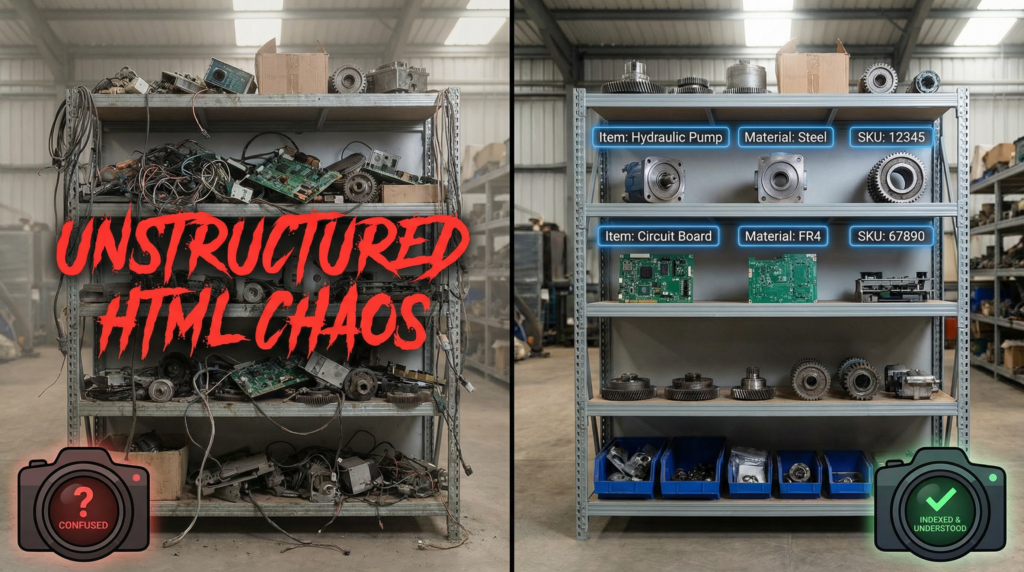
Many of our B2B manufacturing clients struggle to get complex technical products ranked because the specifications are locked inside PDFs or unstructured HTML tables. When you share tabular or structured data, you should offer machine-readable formats like CSV or JSON with proper field typing and metadata.
If you sell complex machinery with hundreds of compatibility variables, providing a data dictionary that explains variables, units of measurement, and field relationships allows LLMs to ingest and understand your catalog’s logic. For massive datasets, implementing proper primary and foreign key relationships and offering multiple granularity levels ensures that the “reasoning” engines behind modern search can answer complex user queries about your products without hallucinating.
Schema markup and structured data are like adding subtitles to a movie. You might understand the plot without them, but the clarity ensures that nothing gets lost in translation. In the context of Magento SEO, this translation layer is often the difference between a product page that generates revenue and one that simply occupies server space.
Ready to ensure your Magento store is accessible to LLMs?